The Blood of Dawnwalker 30-Day Time System: Day, Night, Time Segments
How the 30-day clock really works in The Blood of Dawnwalker: 8 day and 8 night time segments, what spends them, and what happens when they run out.
FAQ
What happens when the 30 days run out in The Blood of Dawnwalker?
How many time segments are there in a whole run?
Does fast travel cost time?
Can you skip or rewind time?
Does sunlight hurt Coen, and is there a morality system?
How Does the 30-Day Time System Work in The Blood of Dawnwalker?
Vale Sangora is the whole stage of The Blood of Dawnwalker, and you have 30 days and 30 nights in it before the story’s deadline lands. Coen’s family is in the hands of Brencis, the Knyaz of Vale Sangora, and the clock is the price of everything you do about that.
Each half-day is chopped into 8 segments — eight for the day, eight for the night — giving roughly 480 time segments for a full run. The game calls them time segments (or time units); the HUD in the top-right shows the current phase label (Dawn, and so on) over a segmented bar, and the quest tracker prints the headline number: “Rescue your family • 26 days left”.
Three rules explain almost all of the pressure:
- Only hourglass-marked actions spend segments. Interactions the game flags with the hourglass icon draw the budget down — and it warns you with a flashing time icon before it charges, so you can back out.
- Moving and fighting are free. Walking, running, exploring, ordinary open-world combat and looting do not advance the clock. You can cross the valley without paying for it.
- Daylight does not punish you. Coen’s transformation was interrupted by silver poisoning, which is what makes him a Dawnwalker: he walks in the sun with no daylight penalty of any kind. Day is simply the half of the cycle where you are human.
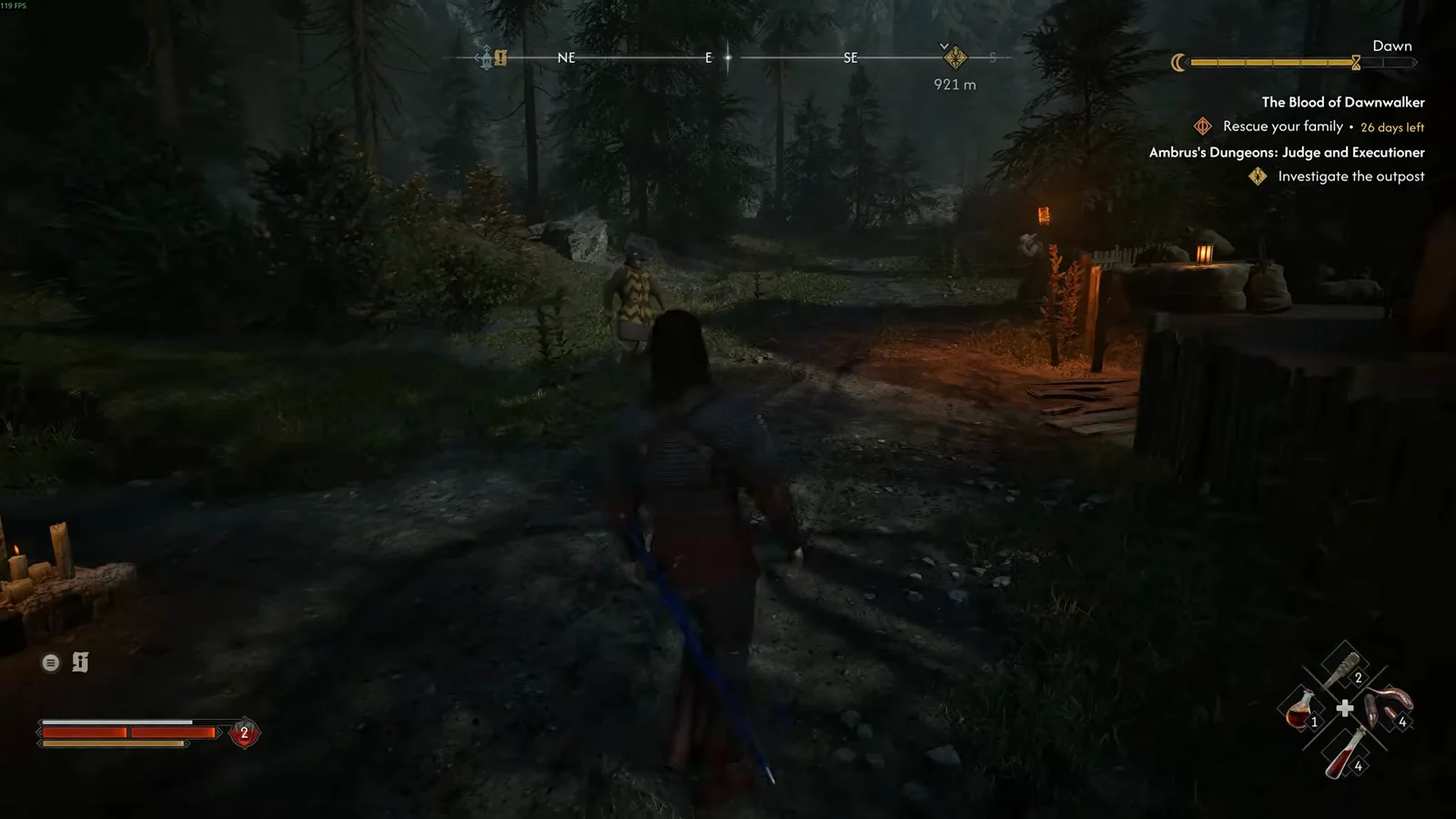
The two time read-outs that matter: the phase bar (segments left in this half-day) and the days-left counter on the objective. Frame from the capture documented on /guides/vampire-powers/.
What Spends Time Segments, and What Is Free?
| Action | Time cost | Documentation status |
|---|---|---|
| Walking / running between locations | 0 | Documented — travel does not push the clock |
| Ordinary open-world combat, looting, exploring | 0 | Documented |
| Court Activity (the marked interaction that resolves it) | 3 time segments for the overwhelming majority | Documented; a small number of exceptions are pending manual review |
| Prologue main quest Bad Blood | ~5 segments, spent at night | Documented; the least precisely published figure in this table |
| Learning certain skill ranks | Hourglass-marked on top of skill points | Documented that it happens; no per-rank table published |
| Skipping ahead at a repaired Road Shrine | Advances the clock to the phase you pick | Documented |
| Drinking Ambrus’s poisoned blood | Coen loses health for up to 9 time segments | Documented on /bosses/ambrus/ |
| Fast travel between repaired shrines | — | Not documented — no source gives a per-jump cost |
| Resting / sleeping for a buff | — | Not documented |
Where Does the Time Actually Go?
There is no act structure to pace you, so the budget is yours to allocate. The campaign’s spine is Brencis’s three Boyar vassals — Ambrus, Bakir and Xanthe — and all three are optional, in any order:
- /bosses/ambrus/ — 14 Court Activities, quest The Gilded Gauntlet
- /bosses/bakir/ — 12 Court Activities, quest The Lunar Game
- /bosses/xanthe/ — 15 Court Activities, quest The Cycle of Love (and she can also be assassinated at night in the Svartrau cathedral with no Anger ramp at all)
Filling a Boyar’s Anger meter takes roughly 75% of their activity list, and each activity is ~3 segments. Do the arithmetic on the full 41-activity sweep (41 × 3 ≈ 123 segments) and it is obvious that you cannot max all three in one run — that derived figure is our calculation, not a published number. Which lines you leave open is the real decision; it is mapped on /guides/one-playthrough-faq/.
What the ~480-segment budget means in practice
480 segments sounds enormous until you notice what actually eats them: main-quest interactions, Court Activities at 3 each, skill ranks with an hourglass, and status effects such as the 9-segment poison DoT. Meanwhile the free half of the game — travelling, clearing camps you stumble into, gathering reagents for /items/forging-materials-guide/ — costs nothing, so there is no reason to rush between objectives. Spend the segments you were going to spend anyway; do not spend them on things the game will not charge for.
What Happens When the 30 Days Run Out?
The game does not end you. Time running out is a narrative outcome, not a failure state: you miss the rescue, the story resolves along another branch, and the world keeps running. The game director said so directly in IGN’s pre-launch coverage — the countdown is a budget that shapes which story you get, not a timer with a lose condition attached, and no “forced bad ending” gate exists at the deadline.
The corollary matters more for planning: you can go straight at Brencis early. Skipping the Boyar lines and storming his castle is a legitimate route — community reports cluster around day 22 for a direct rush, which is player experience rather than an official figure. The prologue duel at Laslea Glen already shows you what you are in for on /bosses/brencis/, and the finale itself is the Grotesque Ascendant fight on that same page.
Outcomes branch on far more than the clock — how you treat each Boyar, who you ally with, how far you let Corruption go. They are catalogued on /guides/all-endings/, and the trophy conditions attached to them on /guides/trophy-guide/ (47 trophies in the verified list).
How Do Day Segments Differ From Night Segments?
The split is not a difficulty dial; it is a kit swap.
Day (8 segments). Human Coen: sword, Witchcraft (its spells burn his own HP, and daylight healing comes only from spells and consumables), shops, and the Court menu — the daytime operations board covered on /guides/court-activities/.
Night (8 segments). Vampire Coen: claws, the Vampirism tree, feeding to raise Corruption, wolf-form travel, and infiltration jobs that are only possible after dark — Xanthe’s cathedral assassination being the headline example.
Run one phase empty and the clock rolls into the other half of the cycle; the form change follows the phase. The exact mid-action behaviour when the last segment of a phase is spent is not cleanly documented, so this page does not state a rule for it.
Infamy, Edicts and Getting Noticed
Going loud is expensive in a different currency. Infamy runs through ranks 1–9, and each escalation makes Brencis respond with edicts: heavier armed patrols in settlements, and merchant prices that climb as your profile rises. The same escalation opens extra quest chains, so it is a trade rather than a pure tax — but budget it as a risk cost, not a time cost: patrols interrupt what you were doing, they do not add a line item to the clock.
The clearest illustration of the trade: killing Xanthe outright in the cathedral jumps Infamy a full rank instantly and forfeits her alliance branch. The route that costs the fewest time segments can cost the most standing.
Road Shrines: The Only Time Technology You Get
The Road Shrine (wayside shrine) is the game’s answer to the fast-travel point, the skill menu and the clock-skip — all three in one object, and none of it works until you repair it:
- Find a shrine whose heart is missing — it is inert.
- Recover the shrine’s heart and restore it.
- Use it for fast travel, for learning skills (the skill panel literally reads GO TO ANY ROAD SHRINE TO LEARN), and for advancing the clock to a chosen phase.
A shrine is also the clean way to cross from a phase where you have nothing left to do into the one where your next hourglass action actually lives — which is why “save the night for vampire work” beats hoarding daylight.
How to Spend the 30 Days
- Pick your Boyar order before you start spending. Ambrus is the documented weakest and the suggested first kill; Xanthe is the Level 25+ bracket.
- Bank segments on free work. Exploration, gathering and clearing what you walk past cost nothing — do it between paid interactions instead of saving up “free days”.
- Repair shrines early. They are the only hop between phases and the only place you can spend points.
- Do not treat the deadline as a fail state. If you want to go for the castle on day 20, that is a playthrough, not a loss — see /guides/difficulty-settings/ if you want the mechanics dialled down while you learn the combat.
- Read the /guides/beginner-guide/ and /guides/best-builds/ once, then stop planning. The build that survives the budget is the one that spends segments on things that pay back in power.
What Is Not Documented
- Per-jump fast-travel cost — no source confirms whether shrine travel is free or metered.
- Exceptions to the 3-segment Court Activity cost — the “overwhelming majority” figure is well attested; the minority is not individually published.
- Segment behaviour at a phase boundary — what happens to a mid-action spend when the last segment of a phase runs out.
- Any way to recover spent segments — none is documented; treat the budget as one-way.
- The day-22 direct-rush figure — community-reported, not official.
Sources & Verification
- Bandai Namco Europe — The Blood of Dawnwalker official site — Vale Sangora, Brencis as the valley’s vampire lord, and Coen’s condition as the daylight-walking Dawnwalker.
- IGN pre-launch coverage / interview with game director Konrad Tomaszkiewicz (via IGN’s Dawnwalker hub) — the statement that the 30 days running out is not a game over: the world continues and the story resolves another way. URL not re-fetched in this environment; treat as a named-but-unlinked source.
- The Verge and 9game.cn launch coverage — the same “the game keeps going after day 30” framing, the option to head straight for the castle, and the half-finished transformation behind the no-sunlight-damage rule. Article URLs not re-fetched here; the claims are corroborated by the Bandai framing above.
- games.gg — The Blood of Dawnwalker beginner’s guide — the 8 + 8 segment cycle, hourglass-marked actions as the only spenders, walking costing nothing, and the absence of a crafting-table loop.
- The Blood of Dawnwalker — Court System Explained by IGN — the Court tab, the three generals, Anger-to-audience unlocking and the infamy/edict gauge.
- Get the PERFECT Start — Time Warning by RageGamingVideos and Beginner Guide — Things I Wish I Knew Sooner by Spectral Life — time as a fixed currency rather than a countdown, eight segments per phase, and the pre-spend warning icon.
- GameSpot — Edicts, Infamy and the Vampire Court guide — Infamy ranks 1–9 and the edict/patrol escalation.
- Rock Paper Shotgun — how to defeat Ambrus — The Bittersweet Toast poison chain and the up-to-9-time-segment DoT on Coen after drinking Ambrus’s tainted blood.
- What happens if you kill Brencis at the start of The Blood of Dawnwalker — prologue Bad Blood context (the duel, its night setting and its segment cost); the ~5-segment figure is read from playthrough coverage rather than a published table, and is flagged as the softest number above.
- Our own audited Boyar pages — /bosses/ambrus/, /bosses/bakir/ and /bosses/xanthe/ — carry the per-Boyar activity counts (14 / 12 / 15), the ~75%-of-list Anger threshold and the Xanthe assassination exception, each with their own cited sources.
- psnine — The Blood of Dawnwalker trophy list — the 47-trophy list the deadline and Boyar choices feed into.
- PowerPyx — All Court Activity locations — the 41-activity total, the 14/12/15 Boyar split and the 3-segment cost. Automated fetch of this page is blocked from our environment, so those fields are carried as pending manual review rather than quoted as directly read.
More The Blood of Dawnwalker Guides
- The operations that eat most of your segments: /guides/court-activities/
- What the night form is for: /guides/vampire-powers/ and /guides/skill-trees/
- Where the deadline actually leads: /guides/all-endings/ and /guides/trophy-guide/
- The endgame clock: /bosses/brencis/
Related Articles
guides
How to Feed in The Blood of Dawnwalker: Blood, Drain & Corruption
The Blood of Dawnwalker feeding guide: the stealth HOLD prompt, Voracious Bite, blood vials, the hunger-dialogue trap, and how feeding raises Corruption.
items
The Blood of Dawnwalker Swordmastery Manuals: Locations & How They Work
How Swordmastery Manuals work in The Blood of Dawnwalker: what they unlock, where to find them in camps and from vendors, and the real cost of each rank.
codes
The Blood of Dawnwalker Codes: No Redeem Codes Exist — What To Do Instead
The Blood of Dawnwalker is a buy-to-play single-player RPG with no redeem, gift or promo codes. Here is why, and how to earn Denarii and gear for real.
Was this helpful?
Thanks for the feedback!